

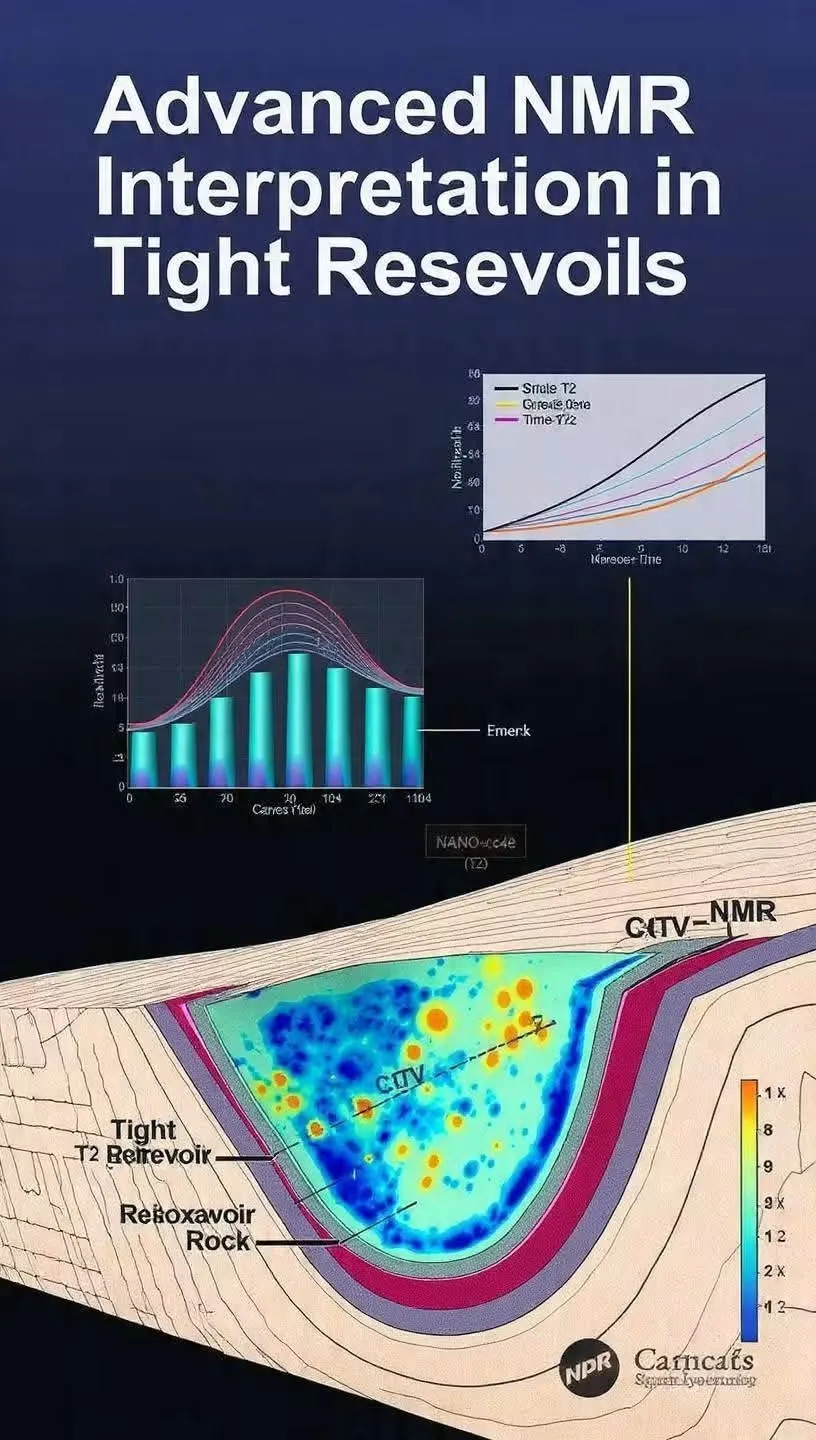
Advanced NMR Interpretation in Tight Reservoirs
Written by Dr.Nabil Sameh
Introduction
Tight reservoirs have become increasingly important in the global oil and gas industry due to the depletion of conventional hydrocarbon resources and the growing demand for energy. These reservoirs are characterized by extremely low permeability, complex pore systems, and heterogeneous rock properties that make reservoir evaluation particularly challenging. Traditional petrophysical methods often encounter limitations when attempting to accurately characterize fluid distribution, pore structure, and producibility in such formations.
Nuclear Magnetic Resonance (NMR) logging has emerged as one of the most powerful technologies for reservoir characterization because it directly measures the response of hydrogen nuclei contained within formation fluids. Unlike conventional porosity logs, NMR provides valuable information about pore-size distribution, fluid mobility, bound and free fluid volumes, and reservoir quality. In tight reservoirs, where pore systems are highly complex and often dominated by micro- and nano-scale pores, advanced NMR interpretation techniques have become essential for obtaining reliable reservoir evaluations.
This article presents a comprehensive theoretical discussion of advanced NMR interpretation in tight reservoirs, focusing on the principles, challenges, interpretation methodologies, pore structure characterization, fluid identification, and emerging developments in the field.
1. Fundamentals of NMR Logging
NMR logging technology is based on the interaction between magnetic fields and hydrogen nuclei present in formation fluids. When hydrogen nuclei are exposed to a magnetic field, they align in a specific orientation. Subsequent excitation and relaxation processes generate measurable signals that provide information about the fluid-filled pore space within the formation.
The NMR response is strongly influenced by pore geometry, fluid properties, and surface interactions. As fluids occupy pores of different sizes, the relaxation behavior varies accordingly. Large pores generally exhibit longer relaxation characteristics, while small pores display shorter relaxation behavior due to stronger interactions between fluids and pore surfaces.
One of the key advantages of NMR technology is its ability to measure formation porosity independently of lithology. This capability makes NMR particularly valuable in complex reservoirs where conventional porosity measurements may be affected by mineralogical variations.
In tight reservoirs, NMR measurements provide critical insight into microscopic pore structures that are otherwise difficult to evaluate using conventional petrophysical techniques.
2. Characteristics of Tight Reservoirs
Tight reservoirs exhibit several unique geological and petrophysical characteristics that complicate reservoir evaluation.
These formations commonly contain extremely small pore throats and highly restricted fluid pathways. The pore network often consists of a combination of intergranular pores, intragranular pores, microfractures, organic pores, and clay-associated pore systems.
The complexity of these pore systems creates significant challenges in distinguishing between producible hydrocarbons and immobile fluids. Conventional porosity and permeability relationships frequently fail to accurately represent reservoir behavior due to the heterogeneous nature of the rock matrix.
Fluid movement within tight formations is often governed by capillary forces, adsorption mechanisms, and pore throat restrictions rather than simple pressure gradients. Consequently, understanding pore-scale characteristics becomes essential for predicting reservoir performance.
Advanced NMR interpretation provides a powerful means of investigating these complex pore structures and assessing reservoir quality beyond traditional methods.
3. Advanced Pore Structure Characterization
One of the most important applications of NMR in tight reservoirs is detailed pore structure characterization.
Advanced interpretation techniques focus on evaluating the distribution of pore sizes and identifying different pore populations within the reservoir. Tight formations frequently contain multiple pore systems that contribute differently to storage and flow capacity.
Large pores generally provide the primary pathways for hydrocarbon production, while smaller pores may contain trapped fluids that contribute little to reservoir deliverability. NMR data can help distinguish these pore classes by analyzing relaxation distributions and identifying dominant pore-size ranges.
Modern interpretation workflows increasingly integrate NMR measurements with geological and petrophysical observations to develop a more comprehensive understanding of reservoir architecture.
Detailed pore characterization enables reservoir engineers to identify productive intervals, evaluate completion targets, and optimize field development strategies.
4. Fluid Typing and Fluid Distribution Analysis
Fluid typing represents one of the most valuable aspects of advanced NMR interpretation.
In tight reservoirs, hydrocarbons often coexist with bound water, capillary-bound fluids, and movable water within highly complex pore systems. Distinguishing these fluid phases is critical for accurate reservoir evaluation.
Advanced NMR analysis enables the identification of different fluid populations based on their relaxation characteristics. Movable fluids generally exhibit different responses than bound fluids because of variations in molecular mobility and pore confinement effects.
The ability to differentiate between producible hydrocarbons and non-producible fluids significantly improves reservoir characterization. This distinction is particularly important in unconventional reservoirs where hydrocarbon recovery depends heavily on understanding fluid distribution at the microscopic level.
Advanced fluid typing techniques support improved reserve estimation and production forecasting by providing a more realistic representation of in-situ fluid behavior.
5. NMR Interpretation in Organic-Rich Tight Reservoirs
Organic-rich tight reservoirs present additional challenges for NMR interpretation.
These formations often contain significant quantities of organic matter that contribute to hydrocarbon storage and influence NMR responses. Organic pores may possess unique characteristics that differ substantially from conventional mineral-hosted pore systems.
Hydrocarbons stored within organic matter frequently exhibit complex relaxation behavior due to restricted molecular movement and strong surface interactions. These effects can complicate fluid identification and pore structure analysis.
Advanced interpretation approaches attempt to separate the contributions of organic and inorganic pore systems to achieve a more accurate assessment of reservoir properties.
Understanding the relationship between organic content, pore structure, and fluid distribution is essential for evaluating the production potential of unconventional reservoirs.
6. Integration of NMR with Other Petrophysical Data
Advanced reservoir evaluation increasingly relies on integrated interpretation methodologies rather than standalone measurements.
NMR data become significantly more valuable when combined with conventional well logs, core analysis, image logs, geomechanical data, and geological observations.
Integrated workflows allow interpreters to validate NMR-derived reservoir properties and reduce uncertainty associated with individual measurements. The combination of multiple datasets improves confidence in porosity estimates, fluid saturation assessments, and reservoir quality evaluations.
In tight reservoirs, integration also facilitates a better understanding of fracture systems, mineralogical influences, and pore network connectivity.
The synergy between NMR and complementary datasets enables more robust reservoir models and supports improved decision-making throughout the field development process.
7. Emerging Trends in Advanced NMR Interpretation
The field of NMR interpretation continues to evolve rapidly as new technologies and analytical techniques are introduced.
Recent developments focus on improving resolution, enhancing fluid discrimination capabilities, and expanding the range of measurable reservoir properties.
Artificial intelligence and machine learning technologies are increasingly being incorporated into NMR interpretation workflows. These tools can analyze large volumes of data, identify subtle patterns, and improve the consistency of reservoir characterization.
Digital rock analysis and advanced pore-scale imaging techniques are also being integrated with NMR measurements to provide a more detailed understanding of pore structure and fluid behavior.
Future developments are expected to further improve the accuracy of reservoir evaluation and enable more reliable predictions of production performance in complex tight formations.
8. Operational and Interpretation Challenges
Despite its significant advantages, NMR interpretation in tight reservoirs remains challenging.
Low porosity, weak signal strength, complex pore systems, and heterogeneous rock properties can complicate data acquisition and analysis. Interpretation uncertainty may increase when multiple pore systems overlap or when fluid responses are difficult to separate.
Environmental conditions, formation mineralogy, and operational constraints may also influence data quality.
Advanced interpretation requires a thorough understanding of reservoir geology, petrophysics, and fluid behavior. Successful application depends on careful data quality control, integrated analysis, and appropriate interpretation methodologies.
Continuous advancements in technology and interpretation techniques are helping to overcome many of these challenges and expand the applicability of NMR logging in increasingly complex reservoirs.
Conclusion
Advanced NMR interpretation has become an indispensable tool for the characterization of tight reservoirs. The technology provides unique insights into pore structure, fluid distribution, reservoir quality, and hydrocarbon producibility that are difficult to obtain through conventional petrophysical methods alone.
As the industry increasingly focuses on unconventional and low-permeability resources, the importance of advanced NMR analysis continues to grow. Detailed pore characterization, fluid typing, organic matter evaluation, and integrated reservoir assessment allow operators to better understand complex reservoir systems and optimize development strategies.
The integration of NMR data with modern digital technologies, artificial intelligence, and advanced petrophysical workflows is transforming reservoir characterization practices. These innovations are improving interpretation accuracy, reducing uncertainty, and supporting more efficient resource development.
In the future, advanced NMR interpretation will remain a cornerstone of tight reservoir evaluation, providing critical information for maximizing hydrocarbon recovery and enhancing decision-making throughout the reservoir lifecycle.
Written by Dr. Nabil Sameh
-Business Development Manager (BDM) at Nileco Company
-Certified International Petroleum Trainer
-Professor in multiple training consulting companies and academies worldwide
-Lecturer at universities inside and outside Egypt
-Contributor of petroleum sector articles for international petroleum magazines and journals
-Author and researcher in Petroleum Engineering, Reservoir Characterization, and Energy Technologies
البوم الصور
اترك تعليقًا

آخر المقالات




اشترك في النشرة الإخبارية
احصل على آخر الأخبار في صندوق البريد الوارد الخاص بك

اشترك في النشرة الإخبارية
الأكثر مشاهدة
عرب

نماذج مشرفة

فن

أخبار مصر

المؤشرات

-
- سياسة
- أعمال
- إقتصاد
- العالم
- رياضة
- صحة
- علوم
- منوعات
- المعرض
- الصور
- الفيديو
- أزياء
- أخبار مصر
- محافظات
- مقالات
- فن
- عاجل
- حوادث
- مطبخ
- مرأة
- ثقافة
- ديني
- تعليم
- عرب
- جامعات
- طقس
- اشعار وخواطر
- بنوك
- برقيات
- شركات
- سيارات
- أدب
- أسواق
- أخبار
- حوار
- أحزاب
- نماذج مشرفة
- تقارير وتحقيقات
- قضايا
- تصريح
- العملات
- صناديق المؤشرات
- الاسهم
- العملات الرقمية
- شهادات
- السندات
- صناديق
- المؤشرات
- السلع
- التضخم
- تحليل أخبارية
- إتصل بنا
التعليقات الأخيرة